91% of marketers who use marketing automation tools confirm that they have a significant impact on their online marketing activities. Today, virtually every company conducts marketing activities – but simply reaching potential customers is not enough. You have to reach them at the right time and through the medium that suits them best.
What is marketing automation?
Marketing automation includes, for example:
- Acquisition and processing of user data
- Segmentation of target audiences
- automatic sending of personalized mailings or marketing content that is dynamically adapted to user behavior
We all use the internet, but not everyone is aware of how many traces we leave behind online. Companies whose websites we visit collect a lot of data – they know which tabs we visit, how long we stay on the site, which ads we click on, and which country we are in. Some tools even record mouse movements and clicks.
How is this possible? With the help of cookies, every movement we make on a website can be recorded. Each of us has a unique IP address, making it possible to link several different activities to a specific user.
Marketing automation tools analyze the collected data and make it easy to use for personalized communication with everyone who has interacted with the brand, for example, by creating an account on the website or signing up for a newsletter. With the help of various tools, you can also plan and execute activities directly, such as:
- Email marketing campaigns
- Social media management
- PPC campaigns on social media
- Sending WhatsApp messages
- Social listening
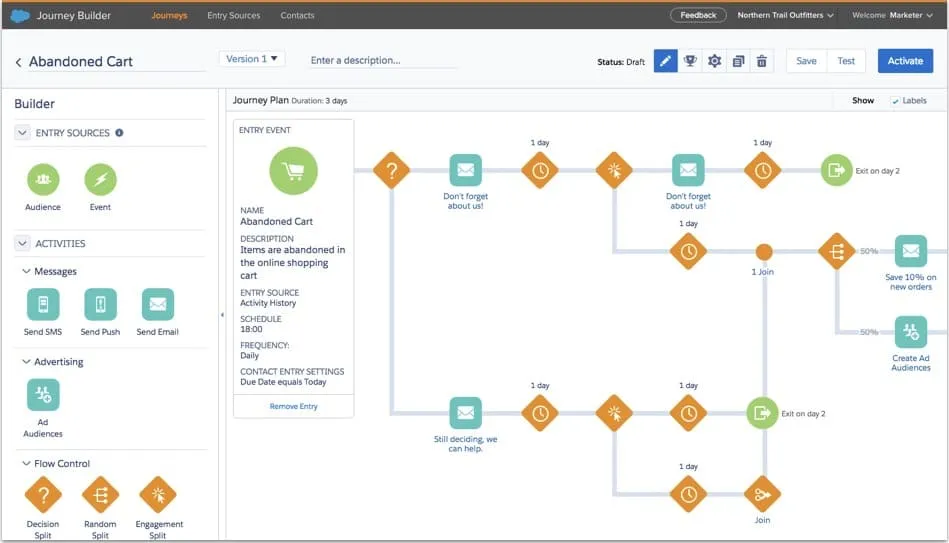
- Building complex customer journeys
- Marketing data analysis

Functions of marketing automation tools in performance marketing
A major advantage of marketing automation tools is the ability to conduct marketing communication with potential customers across various channels. The paths are fully personalized and automated – through data analysis, the automation tool can assign the most effective communication to the user and reach the recipient exactly as they prefer. This is also very important in the context of performance marketing. Personalizing communication significantly increases campaign effectiveness and has a positive impact on metrics such as CPC, CTR, or – in the case of email marketing campaigns – the open rate.
Email marketing in a marketing automation tool
While email marketing may seem like a somewhat outdated form of marketing, it still offers a very high ROI. According to the "The State of Email Marketing" report by Campaign Monitor, 89% of marketers describe their email marketing strategy as effective, with an ROI of 35% and a conversion rate of 47%.
Many automation tools make it possible to send personalized and automated messages to potential customers – for example, a newsletter or an automated message upon webinar registration. In modern tools, creating messages is very easy thanks to the drag-and-drop method. An intuitive panel allows you to create messages without IT knowledge, and the entire process is limited to placing selected elements in the right places and entering the email text.
Personalizing messages with dynamic content is also possible, which in practice means there are different variants of a message. Since MA tools collect data, there is a wealth of information about the people on your mailing list (demographics, location, purchase history, or other interactions with your brand), allowing you to create tailored content. For example, if you run a fashion brand, you can send an offer for dresses to women and an offer for suits to men. Based on the recipient's location, you could also send information about your nearest store.
Scoring – the core of marketing automation activities
If you want to send messages tailored to your target audiences, you first need to divide them into groups. Scoring is a method of classifying recipients based on selected factors. Personalization in marketing automation activities does not have to be based solely on demographic or professional data – you can, for example, also examine the frequency of purchases on your website, email open rates, and much more.
One of the most important factors affecting the conversion rate of your marketing efforts is how engaged your target audience is with your brand. In other words, the likelihood of a desired action being performed on your website (e.g., a purchase) is higher if the person is familiar with your brand, visits the website regularly, or receives (and reads) your newsletter.
Marketing automation tools allow you to personalize your messages based on how users engage with your brand, for example, by using a scoring system.
It could look something like this:
Each action (visiting a website, signing up for a webinar, completing an online purchase, etc.) is assigned a specific numerical value. These actions are monitored and recorded in the system. The more points a user has, the more engaged they are with your brand.
A high score might indicate that a user shops at your store frequently. Communication with this person should therefore focus primarily on maintaining their positive sentiment toward the brand and increasing their average order value. In contrast, communication with a user who has a low score should focus on building a relationship and increasing their brand awareness.
Scoring provides insights not only into the total number of points but also their distribution over time. If a user has accumulated many points, but their score remains stagnant over a long period, you can conclude that you have lost a previously loyal customer. In such a situation, communication should be designed to encourage the customer to return.
Building omnichannel customer journeys with marketing automation
To ensure your marketing measurably supports sales, you should reach your customers across various communication channels. Thanks to the features described above, marketing automation tools can automatically and personally guide customers through a pre-planned path, effectively implementing your lead nurturing strategy. Within this framework, the user is "guided" through all stages of brand engagement: from the first point of contact—such as signing up for a newsletter—to becoming a loyal customer.
These tools automate communication and select the most effective channels based on the needs and expectations of a specific user. Omnichannel customer journeys are an automated sequence of messages that a user receives based on the data available about them.
Imagine an online store user adds products to their virtual cart but doesn't complete the purchase. You could, for example, send an email after one day to remind them of their abandoned cart, and after three days, send a WhatsApp message with a discount code for one of the products. These actions significantly boost e-commerce sales.
Conclusion
As you can see, using marketing automation tools can be incredibly beneficial. You can save a significant amount of work and invest that time elsewhere in building your brand. However, don't forget to regularly review your automated processes and update your automated content.